In reading story metaphorically, which is a way of hearing story that was practiced by rich and poor, educated and non-educated, from ancient times through medieval and Elizabethan times, you learn that most images have true and false versions. You have the image of a mountain, which in its true version can be a meeting with God, while in its false version, could be the monster on the mountain (or top of the tower, or in the attic). True and false images of Home and Paradise occur often in myths, fairy tales, and other longer forms.
I’m currently preparing to teach Rosemary Sutcliff’s retelling of Homer’s The Odyssey, and this morning I read the story of the landing at the home of the Laistrygones. This story is told in Book 10 of The Odyssey, and by Sutcliff at the end of Chapter 3 of The Wanderings of Odysseus. Homer (Lattimore translation) begins the episode with Odysseus telling:
Nevertheless we sailed on, night and day, for six days,
and on the seventh came to the sheer citadel of Lamos,
Telepylos of the Laistrygones….
There as we entered the glorious harbor, which a sky-towering
cliff encloses on either side, with no break anywhere,
and two projecting promontories facing each other
run out toward the mouth, and there is a narrow entrance,
there all the rest of them had their oar-swept ships in the inward
part, they were tied up close together inside the hollow
harbor, for there was never a swell of surf inside it,
neither great nor small, but there was a pale calm on it.
I myself, however, kept my black ship on the outside,
at the very end, making her fast to the cliff with a cable,
and climbed to a rocky point of observation and stood there.
(lines 80-82, 87-97)
Sutcliff describes the area as “a bay that made a safe haven with tall rocks on either side of the entrance”. And after she tells us that Odysseus has his ship (of the 12) tied up at the harbor-mouth, indicating that it was because he was pretty sore with the crewmen of his own ship about an incident that had just happened, she says (in a paragraph all its own):
And well it was for him that he did so.
Well, why is that Ms. Sutcliff? It seems that the king of this land is a monster. Odysseus sends out three of the crew to spy out the country. They first meet a girl at a well drawing water. (How many “girl at a well” stories do you know?) Turns out this “long-armed, broad-shouldered girl” (Sutcliff) is the daughter of the king, and she directs them to his palace. Both Homer and Sutcliff tell us that this monster-king dashes out the brains of one of the spies and lets it be known this will be his supper. The other two spies manage to escape and get back to the ship.
Meanwhile, the monster-king was bellowing for his henchmen; and they came running—huge fellows more like giants than men—and, gathering along the clifftops, they began hurling down rocks upon the ships in the little enclosed harbor beneath. (Sutcliff)
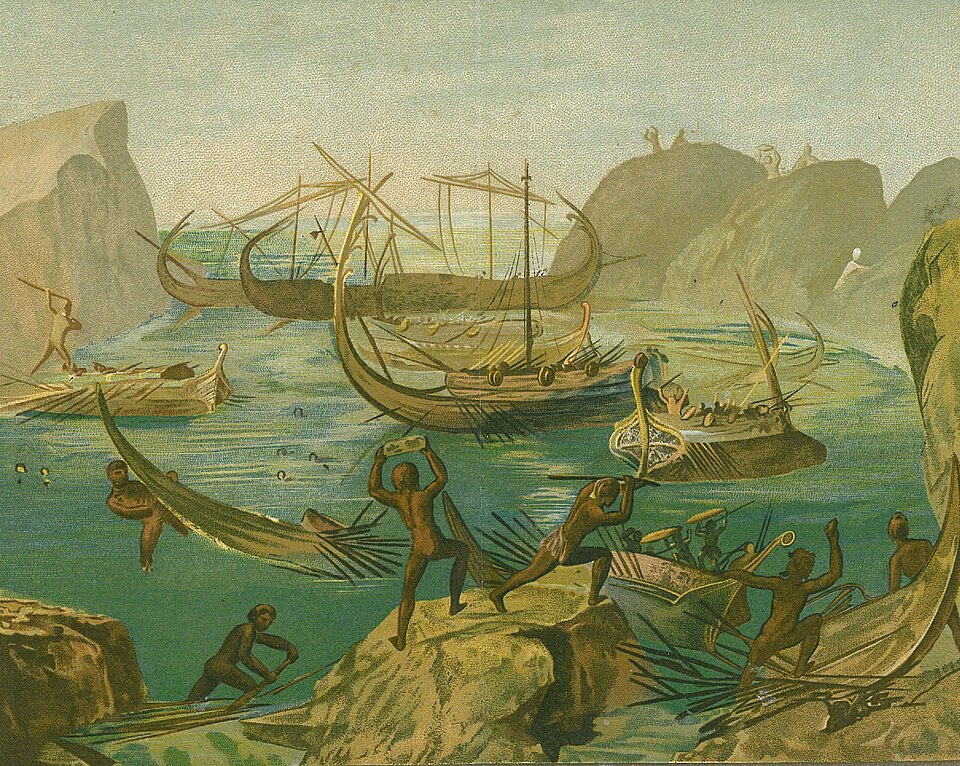
All the ships in that safe haven are destroyed, as well as the men on board. Odysseus’ ship is the only to escape as he draws his own sword and slashes through the hawser that held his ship to the rock. What had for all appearances rightly seemed a safe and secure haven had turned into a trap, whereas Odysseus, perhaps as a punishment to the those on his ship, had stayed outside the ‘safety’, now had the only means to escape destruction. What luck, right? Which is one of my very favorite motifs in story. Maybe one day I’ll write about that.
“To be enchanted by story is to be granted a deeper insight into reality,” wrote Stratford Caldecott. Stories point out to the reality of the world around us, as well as that world beyond our world. There are real dangers in this world. Sometimes the safe haven is really a trap. Hmmm…I wonder what connections I will make as I read a couple of chapters in Brave New World today in preparation for the Literary Life podcast episode this week?