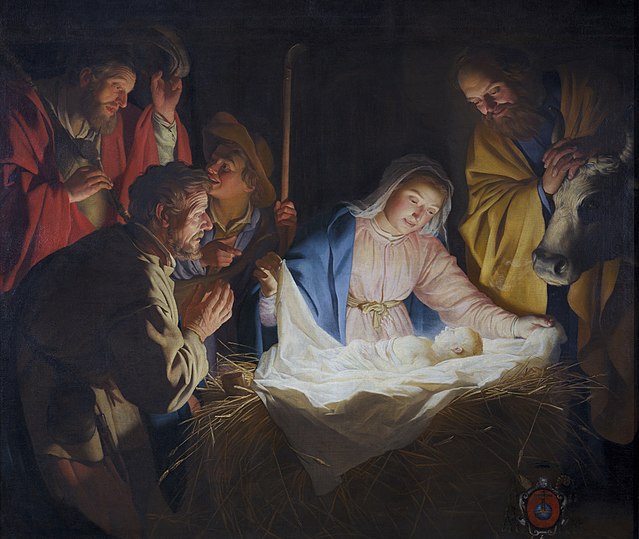
I was raised from birth in an iconoclast culture, and it has only been in studying the literary tradition of reading metaphorically, studies which began as I approached my 60th year, that I have reached a far better understanding of iconography. My impression, which I assume was based on what I was taught, was that Icon = Idol, a thing to be worshiped. My understanding now is that an Icon points not to itself, but out to another reality, often an unseen reality. Just as images in story, including the parables told by Christ, are not ultimately about the very thing happening in the story — a farmer sowing seed, yes, but what is He really showing us? — the Icon is pointing us to something outside of that image. I’ve obviously not become an expert in this, nor have I joined an icon-heavy church to practice and grow in this new understanding, but I’m going to make an attempt to use this idea to explain why December 25th means more to me than it ever has in the past. If I’m using the idea of an Icon wrong, please forgive me. I’m open to learning more.
I am going to skip all the scientific, archaeological, historical proofs, and head on over into the poetic license area and metaphorical reading. I do not care whether or not there is evidence that baby Jesus, son of Mary and Joseph of Nazareth, was born right on December 25th, morning or night, Bethlehem time. I do not care what “pagan” holiday Christians co-opted for their new holiday. What I want to do is look at the image of Winter, and specifically Midwinter, that Christina Rossetti used in her poem that tells of the birth of Christ.
When we are talking of the image of Winter, we are not talking about the calendar dates of December 21 – March 20. In works of the imagination, such as painting, story, song, and poetry, Winter represents a time of darkness and sterility, a time of hopelessness and death. Nature shows us this as well. The trees have lost their green leaves and no life seems to be there until that new growth of Spring. Definitely bleak. But the Midwinter part? I never understood this idea from Rossetti, when, if she’s speaking of December 25, that is only the beginning of Winter — according to the calendar.
Last January 29th the image below appeared on my Facebook feed with the sentiment that you see there — You made it through! And I’ll go ahead and let you see my comment that accompanied my subsequent sharing of the picture.
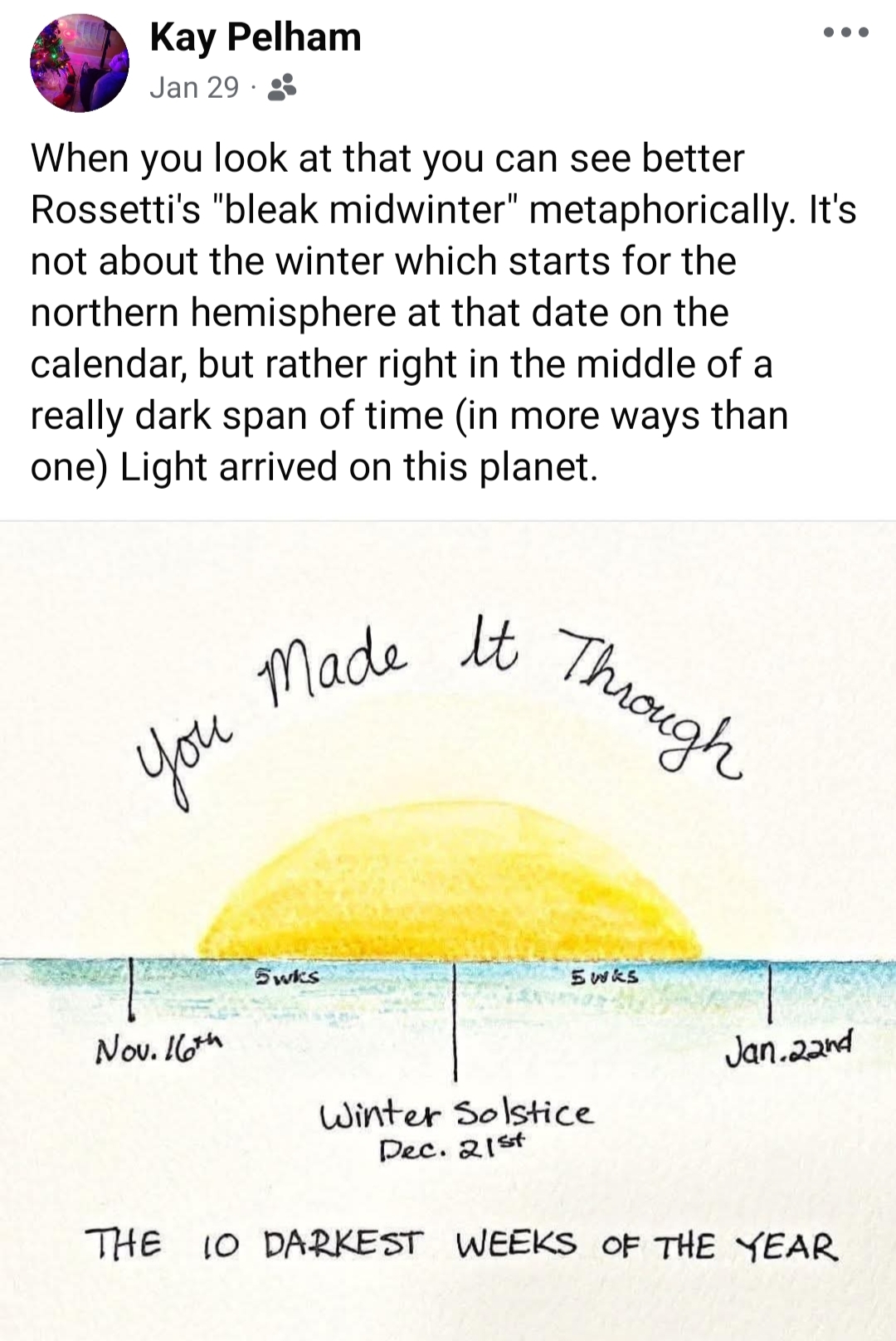
As someone who suffers mildly from ‘seasonal affective disorder’ (or SAD), I definitely appreciated what was being said here. Oddly, maybe, I find the shortest day, the winter solstice, a happy day because I know it’s all uphill from here. So this was a new way of looking at things when the darkest weeks were shown on either side of the solstice. I’m pretty much done and moving on by the 21st of December. But as I stared at this image on that day in January I considered those 10 weeks and how right smack dab in the middle was the 21st, so close to the 25th. (I’ve considered adding a week and a half on either end, giving us 13 weeks, a full quarter, a season.) If the metaphorical image of Winter is Darkness, and we place Winter as the darkest quarter of the year, then right there in our metaphorical Midwinter, the very darkest time, is when we have chosen to celebrate when Light came into this very dark world.
The people that walked in darkness have seen a great light
~Isaiah 9:2
Light is come into the world…He that doeth truth cometh to the light
~John 3:19,21
In him was life; and the life was the light of men.
~John 1:4
While it is true that Winter is not at the same time all over the world, Christina Rossetti was not all over the world. As any poet writing in the imaginative literary tradition, she looked out at the icon of Nature and saw what it reminded her of and the transcendent reality to which it was pointing her. In the darkest time, symbolically, metaphorically, and for some, even physically, and for all, definitely spiritually, Light came into this world. Whether it was in a barn or a cave, it was Divine. How do you ever get past the awe of that! He came to us as a Baby, protected in Mary’s womb, and threatened even at this birth. Although other mythologies have ‘fragments of the truth’, as early and medieval Christians said, there is no other that has the whole story like this. None. For God so loved the world…
And when they had seen it, they made known abroad the saying which was told them concerning this child. And all they that heard it wondered at those things which were told them by the shepherds. But Mary kept all these things, and pondered them in her heart.
~Luke 2:17-19
In the bleak midwinter, frosty wind made moan,
Earth stood hard as iron, water like a stone;
Snow had fallen, snow on snow, snow on snow,
In the bleak midwinter, long ago.Our God, Heaven cannot hold Him, nor earth sustain;
Heaven and earth shall flee away when He comes to reign.
In the bleak midwinter a stable place sufficed
The Lord God Almighty, Jesus Christ.Enough for Him, whom cherubim, worship night and day,
Breastful of milk, and a mangerful of hay;
Enough for Him, whom angels fall before,
The ox and ass and camel which adore.Angels and archangels may have gathered there,
Cherubim and seraphim thronged the air;
But His mother only, in her maiden bliss,
Worshipped the beloved with a kiss.What can I give Him, poor as I am?
If I were a shepherd, I would bring a lamb;
If I were a Wise Man, I would do my part;
Yet what I can I give Him: give my heart.