Below is my transcript from close to the end of the Literary Life Podcast episode with Michael Drout, discussing his new book The Tower and the Ruin. I was so moved by these words from Dr. Drout that I had to spend time pausing, rewinding, playing, etc. in order to type them out for you. But you really must listen to the episode because there is nothing like hearing the man tell the story himself. And the ending of his book that Angelina references here was also very moving to me, and again, if you listen to the audiobook, you can hear the author himself tell the story. I will also add some quotes from the book’s ending at the bottom of this post.

When Dr. Drout told the story of his dying son, I immediately pictured my brother James who died from cancer at the age of 31. I was with James when he died, and it was far from a pretty scene. I had prayed and prayed for James to be healed, but Yes was not the answer that I received. He did not wake and turn to me.
I also thought of my own son James, named for his uncle. James is only a few years older than Dr. Drout’s son was at his death. Because I had already been through the dying scene with my brother, I could easily imagine my own son in that setting as Dr. Drout told his own story. Truth be told, I carry a fear that my son will share the same destiny as his namesake uncle. And, as always, when someone talks of watching his child die, I can’t help but think of my daughter Grace who was only with us 3 weeks.
From the podcast episode:
Angelina: The last chapter is amazing and painful and beautiful, and also you used your own experience to transcend yourself….You do connect it to “On Fairy Stories” explicitly in the last chapter.
Drout: That was a complete piece of luck, a total piece of luck, and I mean it…I had been struggling on that last chapter. I rewrote it so many times. I was very unhappy with it. I’m approaching my deadline. I knew I wanted the last word in the book to be ‘hope’, but I did not know how I was going to get there. And I didn’t even know what the ‘hope’…how I was going to say the word. I just knew I wanted the last word to be ‘hope’, and I just didn’t know where to go. And I picked up “On Fairy Stories” to check a reference to something we were publishing in Tolkien studies. And I slipped it open to the …last page, and there’s that thing …from the Black Bull of Norroway. And I realize, one, I didn’t even know what that story was. I’d read …”On Fairy Stories” like 10 times, and I never had bothered to go and read the Black Bull of Norroway. And yet he ends with this. But the big thing was, he said “and he turned”. That’s the last line. So she has a lament…”Seven years I served for thee. The glassy hill I clamb for thee. The bluidy shirt I wrang for thee. And wilt thou not wauken and turn to me?” And he turned. And I was like, oh, what does this mean? I had this nagging feeling that this was important that I understand this. And I went and read it. And what had been floating around in my head…and it’s hard to talk about, but it’s like that the worst moment was when my wife, my daughter and I ..when our tears…I watched it happen. They actually fell on my son’s face. And I remember thinking, he should wake up. That’s how the story’s supposed to work, right? There’s supposed to be some kind of magic in it that…the tears of the people that love you are supposed to bring you back. And it didn’t. And he didn’t turn. And when the word ‘turn’…just clicked, and I read that story, and I’m like, that’s how I’m in it. That’s how it goes. Because it is a fairy story, there is that eucatasrophe, right? [Drout then goes on to tell the story of the Black Bull of Norroway really quickly, and then ends with] And then he wakes up and turns to her. And everything is good after all that suffering.
…I felt like that something was saying this is what you need to look at. And then it made sense. And even then, there was a lot of cutting and revising because I had thought I was going to say “and it gives us consolation and makes us feel better” [and then it was like] “but nothing can”, and I was going to try to end on that. But no that’s not really true either. And then it just clicked, Oh, you know what? Asking a book to make up for the death of your child. That’s a big ask. You know, that’s maybe like a little too much to ask out of any book, except the Bible. And I was asking too much of it, but there’s something. And I think that something is this — this feeling that you can bear the grief and the loss if it has some kind of shape, if you can understand it and conceptualize it in some way. And then you can have some hope. You know I think about that line from On Fairy Stories –“Joy beyond the walls of the world.” That’s what hope is. …I could have dove into all the stuff in Morgoth’s ring where Tolkien has this debate where they delineate the different kinds of hope, and someone on Reddit ….was saying Drout doesn’t understand the two types of hope…..and I’m like, Yes, I do. But it wasn’t relevant in this case [then he said something about the words for hope was not the point]. He [Tolkien] had thought deeply about these things. But also there was a simple answer, which was the one he gave to Lewis, which is…..Lewis says mythology or lies breathe through silver. And Tolkien was like, well in the Gospel, though, it’s true. And then the wind blows by and converts Lewis to Christianity. I imagine that it was a little more complicated at the time.
Angelina: It’s like Lewis says in The Great Divorce…when you’re living your life forward, nothing makes sense. But at the end, you look back and then everything seems…. [and then Drout spoke over her and I didn’t catch the last word]
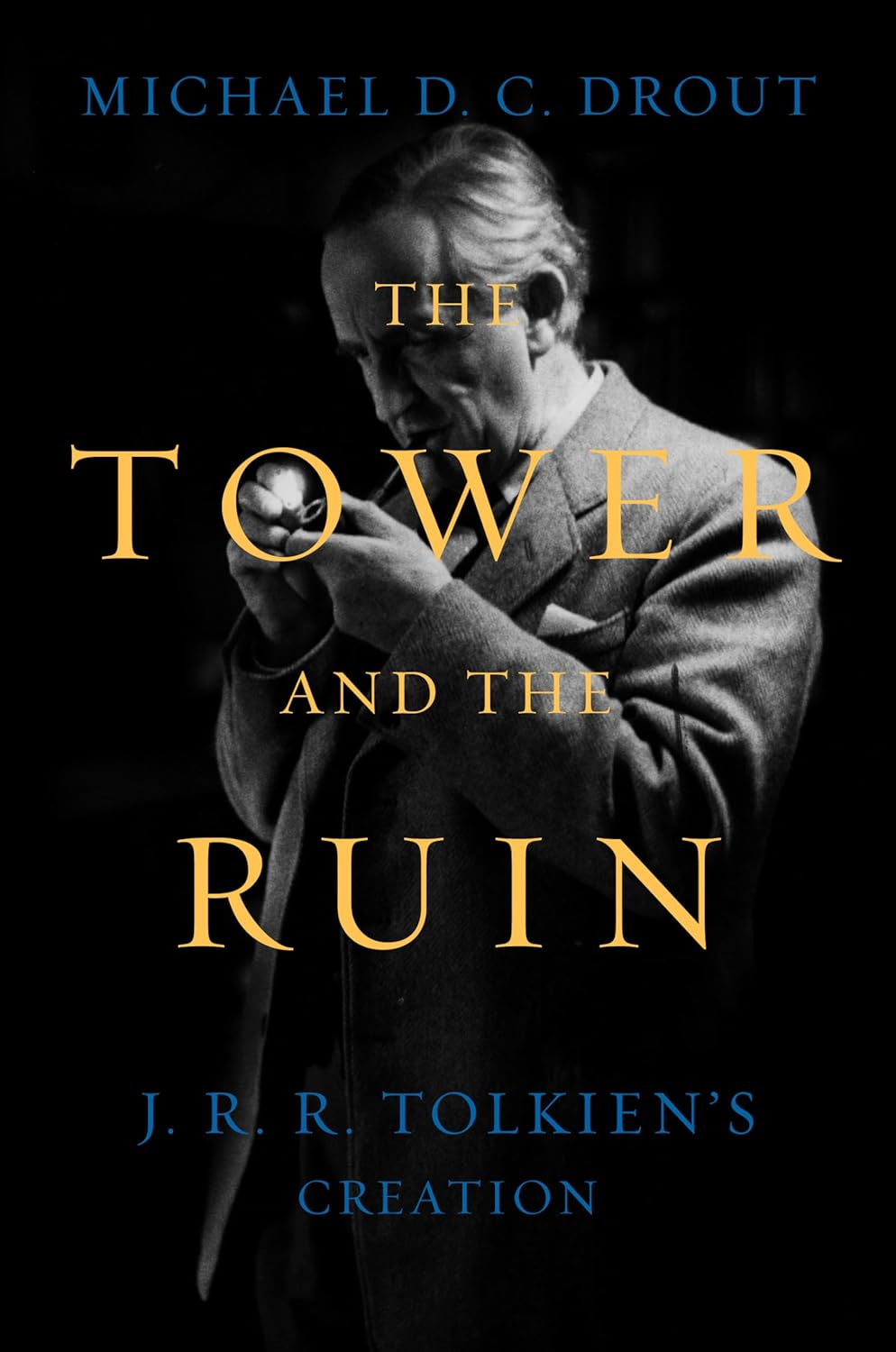
From the ending of Dr. Drout’s The Tower and the Ruin:
I wrote that Tolkien’s works were not a true consolation for me because they did not assuage the pain of the loss of a child, but that is an impossible standard. No literature or art or music, no work of human hands or mind can bring back my son, and nothing less could close the wound his death made. What art can do is to give shape and form to grief and loss, which does not take away the pain but does, in some strange way, make it able to be borne.
I will not give away all of the ending, but I can assure you it does end with hope.
I wish I had time to write about how much I have learned from Tolkien, Lewis, Stanford, Rogers, and now Drout, about the northern way of thinking. They’ve brought me to my people. I am not of hot Mediterranean blood, but of the cold northern people. (Ancestry dot com and my DNA sample have concurred.) Being taught the stories and way of life of the Norsemen and Anglo-Saxons has helped me to come to terms with who I am and why I am as I am. The Mediterranean tales are full of characters running from Death (and then Death is right there in the town to which they had fled). No, my people’s stories are of acceptance of Death and the time of your death. The Norns have spoken. We accept, but we still mourn at the loss of our loved one. It still hurts. Bad. But we have Hope. And perhaps that is why our ‘acceptance’ does not mean that we have lost. We don’t attempt to run from Death, but we do choose to die still being on the right side. There is Hope.
3/9/26 I wanted to add this quote from The Tower and the Ruin. Above in this post is Dr. Drout telling the story on the podcast. Here it is from the book:
“Tolkien ends his essay ‘On Fairy-Stories’ with a passage from ‘The Black Bull of Norroway’ from Andrew Lang’s The Blue Fairy Book. A washerwoman’s daughter has endured a series of awful tasks, including climbing out of a valley of glass using iron shoes nailed to her feet. After much suffering, she is given three chances to wake a sleeping knight, her true love, with her singing, but each evening a witch gives the knight a sleeping potion. Down to her last chance, the girl laments:
Seven long years I served for thee,
The glassy hill I clamb for thee,
The bluidy shirt I wrang for thee;
And wilt thou not wauken and turn to me?
“He heard and turned to her.That last is the moment of eucatastrophe, when, even though logic and pattern-recognition and experience all combine to tell us that there will certainly be no happy ending—there is one. But in our story, on the very worst day, when the tears of his mother, father, and sister all fell upon his face, Mitchell did not waken and turn to us. He did not smile his enormous smile and laugh his deep laugh and ask us why we were crying. We were not in that kind of story. We do not live in that kind of world.”
Blessed are they that mourn: for they shall be comforted. ~Matthew 5:4